
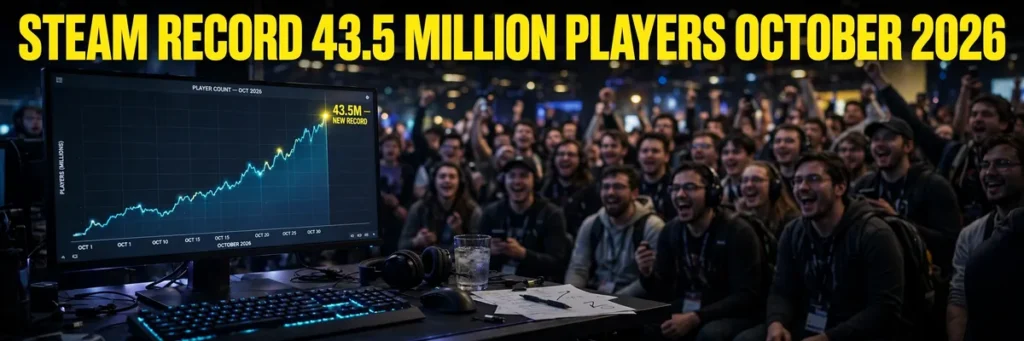
The steam record 43.5 million players october 2026 is real, and it is also easy to misunderstand. On Sunday, October 11, 2026, Steam reached 43,505,724 concurrent users at once, according to SteamDB, the independent tracker that records Valve’s public statistics. That is the highest number of accounts ever logged into Steam at the same time, and it broke a record that had already been broken twice earlier in the same year.
The part most headlines skip is just as important. Those 43.5 million people were not all playing games. SteamDB counted 14,464,385 users actually in a game at the peak moment. That second number is also a record, but it is roughly one third of the headline figure. The other roughly 29 million accounts were logged into the Steam client, browsing the store, chatting with friends, downloading, or simply leaving Steam open.
This guide explains the steam record 43.5 million players october 2026 in plain terms. It separates the two counts that matter, gives the exact figures and the previous records they beat, looks at which games were busy that weekend, and says clearly what the record does not prove. Where a figure comes from SteamDB rather than Valve itself, or where coverage disagrees by a few thousand users, this guide says so instead of rounding the difference away.
Table of Contents
SUMMARY: This table of contents lists every section in this steam record 43.5 million players october 2026 guide, from the exact peak figures to the games, the history, and the questions players ask most.
- Steam Record 43.5 Million Players October 2026: What Actually Happened
- Two Numbers, Not One: Logged In Versus In-Game
- The Previous Records This Peak Beat
- Which Games Were Busy That Weekend
- What Drove the Record, and What Did Not
- A Longer Climb: How Steam Got From 16 Million to 43.5 Million
- What the Record Means for Players
- What the Record Does Not Mean
- Confirmed vs Unconfirmed: What We Know and What We Do Not Know
- Best Plan for Steam Record 43.5 Million Players October 2026
- Frequently Asked Questions
Steam Record 43.5 Million Players October 2026: What Actually Happened
SUMMARY: This section states the steam record 43.5 million players october 2026 plainly: SteamDB recorded 43,505,724 concurrent users on Sunday, October 11, 2026, with 14,464,385 in-game.
Steam’s new all-time peak arrived on Sunday, October 11, 2026. SteamDB, which tracks Valve’s public Steam statistics, recorded 43,505,724 accounts online at the same moment. Reporting on the milestone, including Kotaku, Polygon, and Dot Esports, all pointed to the same SteamDB figure, and it has since stood as Steam’s all-time peak concurrent user count in SteamDB’s records.
The timing within the day was also reported. TechPowerUp, as cited by WindowsForum, reported that the peak came on Sunday, October 11, at exactly 14:00 UTC. That time should be read as a reported time from tracking coverage, not as a figure Valve published in a press release. Valve did not issue a press release about the milestone in the coverage checked for this guide. The record became public through SteamDB’s charts and Valve’s own statistics page, which is how most Steam records become known.
Valve’s own statistics page showed a very slightly different number, and the difference is worth understanding rather than hiding. Valve’s official Steam Stats page, checked on October 12, showed a 48-hour peak of 43,501,449 concurrent users. That is 4,275 fewer than SteamDB’s 43,505,724, a gap of about 0.01 percent. The two pages measure slightly different windows and update at different times, so a small gap is normal. Both figures are above 43.5 million, and both confirm the same milestone. This guide uses SteamDB’s 43,505,724 as the headline all-time peak, because that is the figure SteamDB lists as the all-time record, and it notes Valve’s 43,501,449 alongside it.
One more context point helps put the day in perspective. The record did not arrive during a major Steam sale or a single huge launch weekend. Coverage described it as a regular October weekend, driven by the platform’s usual breadth rather than one event. That matters because it changes how the record should be read. It is not a one-weekend spike that will vanish when a sale ends. It is the latest point on a long, steady climb, and the next section explains the two counts behind it.
Two Numbers, Not One: Logged In Versus In-Game
SUMMARY: This section explains the steam record 43.5 million players october 2026 distinction that matters most: 43.5 million logged in, but only about 14.46 million actually in a game.
Steam publishes two different concurrent counts, and confusing them is the most common mistake in coverage of this record. The first count is concurrent users, meaning accounts logged into Steam at the same time. The second count is players in-game, meaning accounts with a game actually running at that moment. The steam record 43.5 million players october 2026 headline refers to the first count.
At the October peak, SteamDB recorded 43,505,724 concurrent users and 14,464,385 users in-game. In other words, about 33 percent of logged-in accounts were in a game, and about 67 percent were not. The remaining accounts were doing the other things Steam is used for: browsing the store, chatting, managing a library, downloading updates, or leaving the client open while doing something else. None of those uses is fake, but none of them is a person playing a game either.
The in-game figure deserves its own attention, because it also set a record. The previous in-game record was 13,819,439 in March 2026. The October figure of 14,464,385 beat it by about 645,000 users, a gain of roughly 4.7 percent. Some coverage rounded this to “about 14.5 million” or “over 14 million,” which is fair as a summary, but the exact SteamDB figure is 14,464,385, and this guide uses it wherever precision matters.
Why does the distinction matter for ordinary players? Because it stops two opposite misreadings. The first misreading is that 43.5 million people were all playing at once, which would mean Steam’s servers were handling 43.5 million simultaneous games. They were not. The second misreading is that the record is meaningless because most accounts were idle, which is also wrong. A platform with 43.5 million accounts logged in at once, and a record 14.46 million actually playing, is genuinely larger and busier than a platform with a smaller total on both counts. The honest reading holds both numbers at once.
| Measure | October 11, 2026 peak | Previous record |
|---|---|---|
| Concurrent users logged in (SteamDB) | 43,505,724 | 42,686,616 (March 29, 2026) |
| Users in-game (SteamDB) | 14,464,385 | 13,819,439 (March 2026) |
| Concurrent users, Valve official stats page (48-hour peak, checked October 12) | 43,501,449 | Not stated in coverage checked |
| Share of logged-in users in-game | About 33 percent | About 32 percent in March, on the same basis |
The Previous Records This Peak Beat
SUMMARY: This section gives the steam record 43.5 million players october 2026 history: January and March 2026 both set records first, and October beat March by about 819,000 users.
October 2026 was the third time in 2026 that Steam’s all-time concurrent user record was broken. The year began with a first crossing of 42 million, added roughly another half-million in March, and then broke through 43 million for the first time in October. Steam is 23 years old, so a year with three all-time records is unusual, and it shows how quickly the platform’s ceiling has been rising.
The reported 2026 marks, from SteamDB data as summarised in coverage, were 42,042,778 on January 11, 2026, and 42,686,616 on March 29, 2026. October’s 43,505,724 beat the March figure by 819,108 users, a gain of about 1.9 percent, roughly seven months after the March record. That gap is worth noting. It is a large absolute number, nearly a million accounts, but a modest percentage gain on a base of more than 42 million. Steam’s growth at this scale looks like steady accumulation, not sudden jumps.
The in-game record followed the same pattern. March 2026 set the previous in-game high at 13,819,439, and October beat it with 14,464,385. Both counts moving higher together is a useful check. If only the logged-in count had risen, the record could have been explained by more people leaving the client open. Because the in-game count also rose to a new high, the record reflects more real playtime as well as more logins.
Some coverage described October as the second record of 2026 rather than the third, counting only the March and October peaks, or counting January differently. The SteamDB figures themselves are clear: January, March, and October each set a new all-time logged-in peak in 2026. This guide counts all three, because all three figures appear in the SteamDB-based summaries checked.
- January 11, 2026: 42,042,778 concurrent users, the first crossing of 42 million.
- March 29, 2026: 42,686,616 concurrent users, a new all-time peak.
- October 11, 2026: 43,505,724 concurrent users, the first crossing of 43 million.
- In-game: 13,819,439 in March 2026, then 14,464,385 in October 2026.
Which Games Were Busy That Weekend
SUMMARY: This section lists the steam record 43.5 million players october 2026 weekend’s busiest games, with the warning that their 24-hour peaks were not all recorded at the same moment as the platform peak.
A platform record is the sum of thousands of games, not the achievement of one title, and the October weekend shows that clearly. The busiest games were the usual long-running leaders, plus two newer names that had recently peaked. Their figures below are 24-hour peaks around the record weekend, as reported from SteamDB, not a snapshot of the exact moment Steam crossed 43.5 million. That warning matters, because adding the top games together does not reproduce the platform total, and no single game caused the record on its own.
Counter-Strike 2 led the weekend with a 24-hour peak of 1,404,227 players, according to Dot Esports and other SteamDB-based reporting. Dota 2 followed with 1,034,493 players in the same 24-hour window. PUBG: Battlegrounds recorded 713,683 concurrent players in that period. Those three games alone account for more than 3.1 million players in a day, which is a large share of the 14.46 million in-game peak, but still only about a fifth of it. The rest came from the long tail of Steam’s catalogue, thousands of smaller games played at the same time.
Two newer stories stood out in coverage of the weekend. Aion 2, NCSoft’s free-to-play MMORPG, launched globally on October 5, 2026, and recorded an all-time peak of 397,905 concurrent players, according to SteamDB figures cited by Dot Esports. Deadlock, Valve’s multiplayer game still in invite-only testing, reached an all-time peak of 262,145 players following its September 30 patch, passing Team Fortress 2’s historical Steam peak in the process. Both are real peaks, but neither should be described as the cause of the platform record. SteamDB’s charts do not establish how much any one game drove the overall peak, and coverage was careful to say so.
| Game | 24-hour or all-time peak around the record weekend | Notes |
|---|---|---|
| Counter-Strike 2 | 1,404,227 (24-hour peak) | Weekend’s busiest game |
| Dota 2 | 1,034,493 (24-hour peak) | Second busiest; some Valve stats listings show 1,034,502 for a different window |
| PUBG: Battlegrounds | 713,683 (24-hour peak) | Third busiest |
| Aion 2 | 397,905 (all-time peak) | Global launch October 5, 2026 |
| Deadlock | 262,145 (all-time peak) | Invite-only Valve game, after September 30 patch |

What Drove the Record, and What Did Not
SUMMARY: This section explains what the steam record 43.5 million players october 2026 was and was not driven by: broad catalogue strength and steady growth, not one launch, sale, or game.
The most honest answer to “what caused the record” is also the least exciting one, and coverage was unusually consistent on it. Kotaku, reporting Eurogamer’s SteamDB-based figures, noted that there was no specific massive spike behind the record, but rather the continued gradual accumulation of users. ThinkComputers made the same point in different words: the record coincided with activity across Steam’s large catalogue, including established multiplayer games and newer releases, but the available figures do not establish how much any one game drove the peak.
That gradual-accumulation explanation fits the history in the previous section. Steam’s peak has risen almost every October for years, from the low twenties of millions in 2020 and 2021 to the high thirties in 2024, past 41 million in October 2025, and now to 43.5 million. A single launch does not produce that shape. A growing installed base, more free-to-play games, more regions coming online, and more players keeping Steam open as a social and store app do.
What the record was not is equally clear. It was not a Steam sale record, because no major sale was running that weekend in the coverage checked. It was not a single-game record, because no one game supplied anything close to a majority of the in-game total. It was not a holiday record, because mid-October sits outside the usual winter holiday spike, and coverage noted that the surge arrived well outside the holiday sales window. And it was not a press-release milestone, because Valve did not announce it in a statement; the charts announced it.
One estimated figure that appeared in coverage deserves a careful label. Alinea Analytics estimated that Steam generated a record $1.7 billion in revenue during the month, helped by releases including Wardogs, Onimusha: Way of the Sword, and The Blood of Dawnwalker, according to Dot Esports. That is an analyst estimate, not a Valve financial report, and this guide does not use it as proof that the record caused a revenue record. Revenue, player counts, and logged-in counts are three different measures, and a high weekend for one does not automatically prove a record for the others.
A Longer Climb: How Steam Got From 16 Million to 43.5 Million
SUMMARY: This section puts the steam record 43.5 million players october 2026 in a longer October trend, from about 16 million in 2018 to 43.5 million in 2026.
Steam’s October peak has grown almost without interruption for nearly a decade, according to SteamDB figures summarised by KitGuru. The table below uses that summary, so it should be read as a SteamDB-based trend rather than a Valve-published annual report. Even with that caution, the shape is striking: the platform has added roughly 27 million to its October concurrent peak in eight years.
The early part of the climb was slow. October peaks sat at 16.3 million in 2018 and 16.8 million in 2019. The COVID-19 pandemic period brought a step change, with 23.1 million in October 2020 and 26.5 million in October 2021, as more people played at home and Steam’s social and store features became a daily habit for millions. Growth then continued rather than reversing: 30.2 million in October 2022, 31.3 million in October 2023, and 38.1 million in October 2024.
The last two Octobers show the pace at the top end. KitGuru’s summary put the October 2025 peak at 41.6 million, and October 2026 at 43.5 million, a gain of about 1.9 million in a year. That is slower in percentage terms than the pandemic jump, but it is still nearly two million additional simultaneous accounts on a platform that was already the largest PC gaming store. At this scale, even a 4 to 5 percent annual gain means millions more people online at once.
| October | Peak concurrent users (SteamDB-based summary) |
|---|---|
| 2018 | 16.3 million |
| 2019 | 16.8 million |
| 2020 | 23.1 million |
| 2021 | 26.5 million |
| 2022 | 30.2 million |
| 2023 | 31.3 million |
| 2024 | 38.1 million |
| 2025 | 41.6 million |
| 2026 | 43.5 million (43,505,724 on October 11) |

What the Record Means for Players
SUMMARY: This section explains what the steam record 43.5 million players october 2026 means in practice: bigger matchmaking pools, a healthier catalogue, and a platform that is still growing.
For players, the most direct meaning of the record is matchmaking. A platform with 14.46 million people in-game at once, led by Counter-Strike 2, Dota 2, and PUBG, has deep player pools for its biggest games at almost any hour. That does not guarantee a good match in a small or niche title, but it does mean the largest games are unlikely to struggle for players, and it means new free-to-play releases can find an audience quickly, as Aion 2 did in its launch week.
The record also means Steam’s catalogue model is still working. Unlike a single-game record, which can be driven by one hit, a platform record driven by thousands of games suggests breadth. Players are not all playing the same three games. The top three accounted for roughly a fifth of the in-game peak, which leaves roughly four fifths spread across everything else, from long-running MMOs to new releases to small indie titles. For a player looking for something unusual, that breadth is the point of Steam, and the record is evidence that it is still there.
There is a practical meaning for hardware and store expectations too. A platform handling 43.5 million simultaneous logins, with 14.46 million in games, needs server, download, and store capacity at a scale few other gaming services reach. Valve’s statistics page exists, in Valve’s own description, to help spot problems earlier and improve the service. A record weekend with no major outage reported in the coverage checked is, quietly, part of the story. The platform absorbed its biggest weekend ever without the record itself becoming a story about downtime.
Finally, the record is a useful reality check against claims that PC gaming is shrinking. It is not, on this measure. Steam’s concurrent peak has risen in almost every October for eight years, and 2026 set three all-time records. That does not mean every PC game succeeds, or that consoles and mobile are less popular. It means Steam, as a platform, is larger than it has ever been, and its growth has not stalled at the 40 million mark that once looked like a ceiling.
What the Record Does Not Mean
SUMMARY: This section lists what the steam record 43.5 million players october 2026 does not prove, so readers are not misled by the headline number.
A record this large invites exaggeration, so this section states the limits plainly. First, the record does not mean 43.5 million people were playing games. Only 14,464,385 were in-game at the peak. Any article, video, or post that says “43.5 million players were playing on Steam at once” is wrong by about 29 million, and readers should treat it as a mistake, not a rounding choice.
Second, the record does not mean Steam has 43.5 million daily or monthly users in the sense most people use those terms. Concurrent users is a momentary measure: accounts online at the same instant. Daily active users and monthly active users are different measures, counted over a day or a month, and they are much larger. For comparison, Valve’s Digital Services Act notice reported an average of 31.1 million monthly active recipients in the European Union alone between August 2025 and January 2026. That is a regional monthly figure, not a global concurrent figure, and the two should not be compared directly.
Third, the record does not mean any one game is suddenly more popular than the platform total suggests. Counter-Strike 2’s 1,404,227 and Dota 2’s 1,034,493 are 24-hour peaks, not simultaneous counts at the platform peak moment, and they were not necessarily recorded at the same time as each other. Adding game peaks together to explain the platform peak is a category error, and coverage was careful not to do it.
Fourth, the record does not predict the next milestone. Coverage after the record asked how soon Steam might cross 44 million, but no date for that milestone has been announced or can be derived from one weekend. Steam’s growth has been steady, but steady growth does not guarantee a date, and a future record could come in a sale weekend, a launch weekend, or another regular weekend like this one.
- It does not mean 43.5 million people were playing at once; 14.46 million were in-game.
- It does not mean 43.5 million daily or monthly users; concurrency is a momentary measure.
- It does not prove one game caused the record; no single game supplied a majority.
- It does not set a date for 44 million; no such date has been announced.
- It does not measure paying users, sales, or revenue; those need separate figures.
Confirmed vs Unconfirmed: What We Know and What We Do Not Know
SUMMARY: This section puts every key steam record 43.5 million players october 2026 claim in one table, with a clear status label, so readers can tell at a glance what is confirmed, reported, or unconfirmed.
The table below is the safest way to read the whole story. Anything marked confirmed comes from SteamDB’s recorded figures as reported by multiple reputable outlets, or from Valve’s own statistics page. Anything marked reported comes from a single outlet’s timing or summary. Anything marked unconfirmed has no source behind it in the material checked.
| Topic | Claim | Status |
|---|---|---|
| All-time peak, logged in | 43,505,724 concurrent users, October 11, 2026 (SteamDB) | Confirmed in SteamDB-based reporting |
| In-game peak | 14,464,385 users in-game at the peak | Confirmed in SteamDB-based reporting |
| Valve official stats figure | 43,501,449 (48-hour peak, checked October 12) | Confirmed on Valve’s stats page as reported |
| Peak time | Sunday, October 11, 14:00 UTC | Reported (TechPowerUp via WindowsForum) |
| Previous overall record | 42,686,616, March 29, 2026 | Confirmed in SteamDB-based reporting |
| Previous in-game record | 13,819,439, March 2026 | Confirmed in SteamDB-based reporting |
| January 2026 record | 42,042,778, January 11, 2026 | Confirmed in SteamDB-based reporting |
| Top games that weekend | CS2 1,404,227; Dota 2 1,034,493; PUBG 713,683 (24-hour peaks) | Confirmed as 24-hour peaks, not simultaneous |
| Aion 2 peak | 397,905 all-time peak, global launch October 5, 2026 | Confirmed in SteamDB-based reporting |
| Deadlock peak | 262,145 all-time peak after September 30 patch | Confirmed in SteamDB-based reporting |
| Cause of the record | One game, sale, or launch caused it | Not established; coverage points to broad, gradual growth |
| Valve statement | Valve issued a press release about the record | Not found in coverage checked |
| Monthly revenue record | $1.7 billion in the month (Alinea estimate) | Estimate only, not a Valve report |
| 44 million date | A date for the next milestone | Not announced |
| Offline players | Players offline without connecting to Steam counted | No; offline players are not in Valve’s player-count API |
Best Plan for Steam Record 43.5 Million Players October 2026
SUMMARY: This section gives a practical plan for the steam record 43.5 million players october 2026 news, using only the confirmed peak figures and the games that were actually busy.
First, use the right number when you talk about the record. Say Steam reached 43,505,724 concurrent users logged in, with 14,464,385 actually in-game, on October 11, 2026. That sentence is accurate, it credits SteamDB, and it avoids the most common error in coverage of this story. If you only remember one figure, remember the pair, not the headline alone.
Second, if you want to check the record yourself, use the sources that recorded it. SteamDB’s charts page for the Steam client application (app 753) is the tracker behind the headline figure, and Valve’s own Steam Stats page shows the official concurrent count. Both are public, and both will show a different number on any given day, because they measure different windows. A lower number on a weekday is not a contradiction of the record; records are peaks, not everyday levels.
Third, if you are choosing what to play, let the weekend’s shape guide you rather than the headline. The busiest games were Counter-Strike 2, Dota 2, and PUBG, which have deep player pools, and the newer peaks came from Aion 2’s launch week and Deadlock’s update. A new free-to-play launch or a major patch is a better signal for a busy game than a platform record, because platform records are driven by the whole catalogue, not by one title.
Fourth, do not wait for 44 million as if it were an event. No date has been announced, and the next record could arrive on a sale weekend, a launch weekend, or another ordinary weekend. The trend to watch is the October-to-October climb and the in-game count, not a single round number. If the in-game count keeps rising alongside the logged-in count, Steam is genuinely busier, not just more logged in.
For the official details behind this guide, see the Steam record coverage, the SteamDB-based record analysis, and the Steam concurrent users record report. For more gaming coverage, visit Elite Play Zone, browse the Elite Play Zone News section, and browse the Elite Play Zone Gaming section.
Frequently Asked Questions
SUMMARY: This section answers the six questions players ask most about the steam record 43.5 million players october 2026, using only the confirmed peak figures and the distinctions from this guide.
What is the steam record 43.5 million players october 2026?
The steam record 43.5 million players october 2026 is Steam’s all-time concurrent user peak of 43,505,724 accounts logged in at once on Sunday, October 11, 2026, according to SteamDB. At the same peak moment, 14,464,385 users were actually in a game, which was also a record.
Were 43.5 million people all playing games at once?
No. Only 14,464,385 users were in-game at the peak. The 43,505,724 figure counts all accounts logged into Steam at the same time, including people browsing the store, chatting, downloading, or leaving the client open. The difference is about 29 million accounts.
What was Steam’s previous record before October 2026?
The previous overall record was 42,686,616 concurrent users on March 29, 2026, and before that 42,042,778 on January 11, 2026. October beat March by 819,108 users, about 1.9 percent. The previous in-game record was 13,819,439 in March 2026, beaten by October’s 14,464,385.
Which games were the most played during the record weekend?
Counter-Strike 2 led with a 24-hour peak of 1,404,227 players, followed by Dota 2 at 1,034,493 and PUBG: Battlegrounds at 713,683. Aion 2, launched globally on October 5, reached an all-time peak of 397,905, and Deadlock reached 262,145 after its September 30 patch. These are 24-hour or all-time peaks, not a snapshot of the exact platform peak moment.
Why did Steam break its record in October 2026?
No single game, sale, or launch has been established as the cause. Coverage points to broad, gradual growth across Steam’s catalogue, with established games staying busy and newer releases adding players, on a regular October weekend rather than during a major sale. Steam’s October peak has risen almost every year since 2018.
Will Steam reach 44 million concurrent users next?
No date for 44 million has been announced, and none can be derived from the October record alone. Steam’s peak has grown steadily, and the next record could come during a sale, a launch, or another regular weekend. The in-game count, not just the logged-in count, is the figure to watch for genuine growth.
For More Updates Visits: ELITE PLAY ZONE